


 Add Category
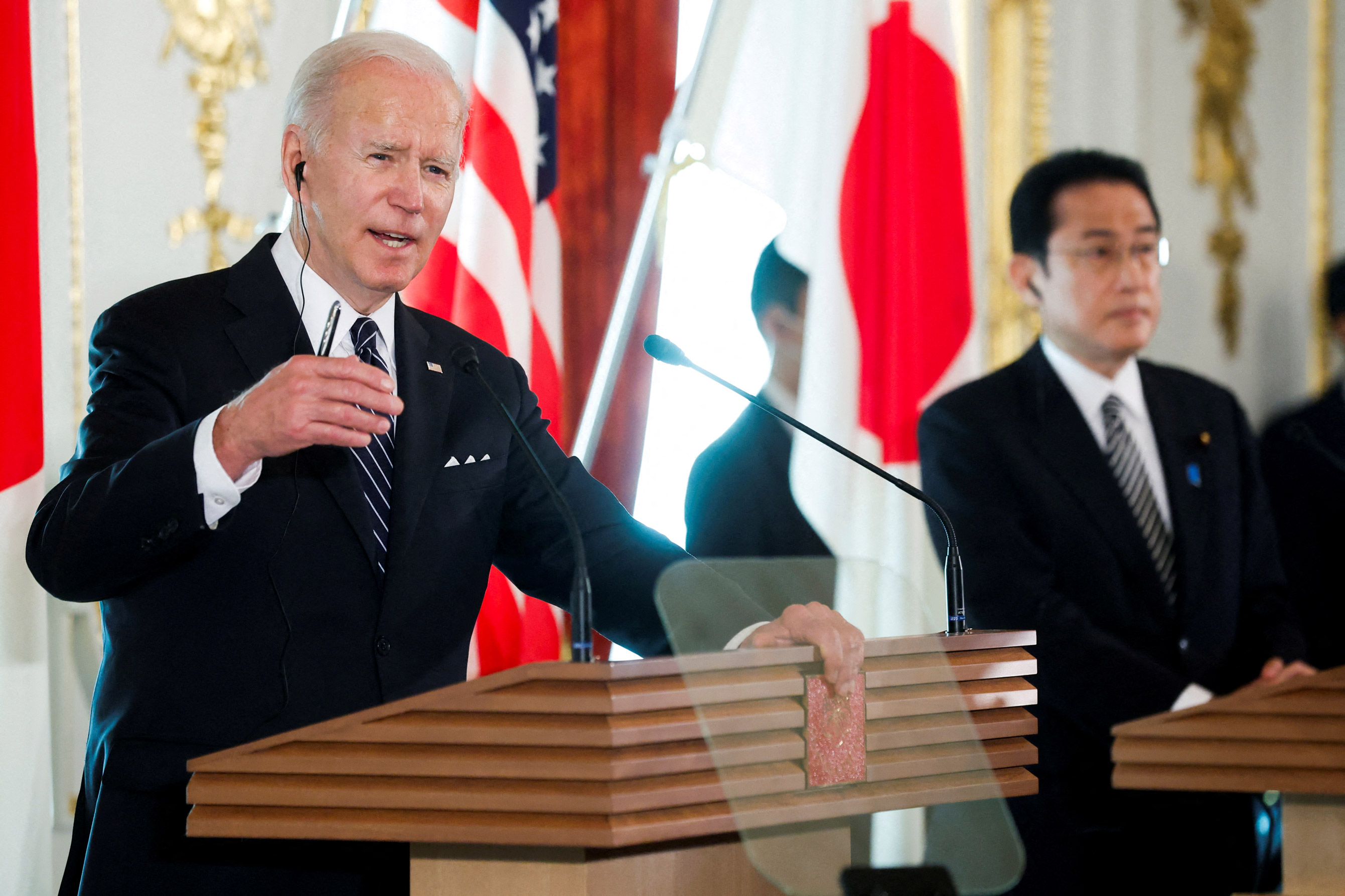
US President Joe Biden's comment in Tokyo on Monday that Washington would intervene militarily if China attacks Taiwan sent shockwaves through the region.
That's because it appeared to be a marked change from a decades-old policy of "strategic ambiguity," under which the US has remained deliberately vague about whether it would come to the democratically ruled island's defense in the case of an attack by China.
The White House swiftly walked back the comments, saying they did not in fact reflect a change in policy — a move that suggested either Biden had misspoken or that his comments were misconstrued.
But at least one analyst who spoke to CNN wonders if the apparently mixed messages are part of a deliberate plan by the White House to communicate its support to allies in the region while avoid crossing China's red lines.
Corey Wallace, assistant professor at Kanagawa University in Japan, pointed out that this was the third time in recent months that Biden had said the US would protect Taiwan from a Chinese attack — and the third time his comments had been hastily reeled in.
“While each time White House officials appear to walk back the statements, after a while you wonder if that is the plan,” Wallace said.
The fact that Biden continues to make such statements may indicate a pattern — and be a way of communicating different messages to different audiences, he added.
“It is also plausible that there is some messaging there for allies in Asia, even as they preserve plausible deniability with (China),” he said.
The US' policy of "strategic ambiguity" is designed to avoid antagonizing China, which is adamant the democratically self-ruled island of Taiwan is part of its territory, despite never having ruled it.
Beijing has pointedly not ruled out taking the island by military force, so it's not surprising that Biden's comments were celebrated in Taiwan.
Given the comments seemed to raise the possibility of a military clash between the US and China, it's also not surprising that China responded angrily — warning Washington that "those who play with fire will certainly burn themselves".
Asked on Monday at a news conference in Japan if Washington would come to Taipei’s aid in the event of a Chinese military move on the island, Biden had said, “That’s the commitment we made.”
He also compared a potential invasion of Taiwan by China to Russia’s invasion of Ukraine earlier this year, warning, “It will dislocate the entire region.”
Wallace, like other analysts, felt the reference to Ukraine was particularly provocative to China.
"[The] United States has not recognized Taiwan’s status as a sovereign country, and considers Taiwan’s status as ‘unsettled’ — quite different from how it views Ukraine,” Wallace said.
But again, while this appears to undermine the policy of "strategic ambiguity," there also appears to be a get-out clause.
“Biden could probably spin this as meaning an invasion of Taiwan would be like Ukraine in terms of unsettling the security environment,” Wallace said.
Watch Biden's comments on Taiwan